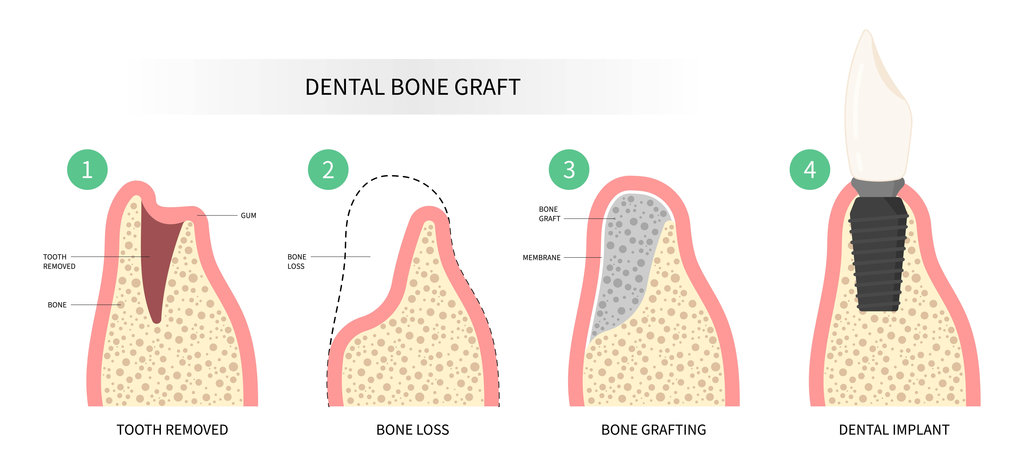
Bone grafting is typically needed when the jawbone lacks enough height, width, or density to securely support a dental implant, a situation that commonly develops after tooth loss, gum disease, or years of wearing dentures. Not every implant patient needs a bone graft, but for many people who have gone months or years without replacing a missing tooth, added bone becomes a necessary step before implant placement can move forward safely.
At Goodove Oral Surgery, we provide bone grafting for patients throughout Virginia Beach and Chesapeake who are preparing for dental implants or other restorative treatment, one of many advanced dental procedures we offer at both locations. Our team walks you through every stage of the process, from the initial evaluation that determines whether grafting is necessary through the healing period that follows.
What Is Bone Grafting?
Bone grafting is a surgical procedure that adds bone material, whether from your own body, a donor source, or a synthetic substitute, to an area of the jaw where natural bone has deteriorated or never fully developed. Once placed, the graft acts as a scaffold that your own bone-forming cells grow into and around, a biological process called osseointegration. Over several months, this new tissue matures and fuses with your existing jawbone, creating a stronger foundation for dental implants or other restorative work.
Bone grafting is one of the most routinely performed procedures in oral and maxillofacial surgery, and it supports far more than implant placement alone. It also plays a role in denture stabilization, sinus lift procedures, and reconstruction following facial trauma. Because this work involves the surgical placement of graft material near the sinuses, nerves, and vital structures of the jaw, it is typically performed by an oral surgeon who has completed additional years of surgical training beyond general dental school.
Who Needs Bone Grafting?
When a tooth is lost and not replaced, the jawbone in that area no longer receives the stimulation it needs from the tooth root, so it begins to shrink. According to the American Academy of Implant Dentistry, the surrounding bone can deteriorate by roughly 25 percent within the first three months after tooth loss and by as much as 50 percent within six months. Without enough remaining bone, an implant cannot be placed securely, which is where grafting comes in.
Bone grafting is commonly recommended for patients who have experienced gum disease, facial trauma, or a congenital condition that limited jaw development. Patients who have worn dentures for many years often need grafting as well, since dentures do not stimulate the jawbone the way natural tooth roots or implants do. Some patients pursue grafting specifically to restore facial support and correct the sunken appearance that comes with significant bone loss, while younger patients who lose a tooth to injury or infection benefit from early grafting that helps preserve their facial structure as they continue to develop.
Hampton Roads veterans are an important part of our practice. Service members who experienced dental trauma during deployment, or who went extended periods without consistent dental access, sometimes arrive at our office with bone loss they had not been aware of. When bone grafting is documented as part of a treatment plan tied to a service-connected dental condition, VA dental benefits or the Community Care Network may help cover the cost for qualifying veterans. Dr. Peter Zagursky, a retired Army Colonel who completed multiple deployments overseas, brings that firsthand perspective to every veteran patient he treats.
Because the strength of the surrounding bone has a direct effect on how long an implant can be expected to last, addressing bone loss early is often one of the most important factors in long-term implant success.
Is Bone Grafting Always Necessary Before Dental Implants?
Not every implant patient needs a bone graft. If you replace a missing tooth relatively soon after extraction, your jawbone often retains enough height and density to support an implant without additional bone work. The determining factor is not simply whether a tooth is missing, but how much healthy bone remains at the site and how long it has been since the tooth was lost.
This is one of the reasons a thorough evaluation matters so much before implant treatment begins. During your oral surgery consultation, we review your dental and medical history, take detailed imaging, and measure the bone available at the implant site. Patients with moderate bone loss are sometimes candidates for implant approaches that reduce the need for grafting, though this depends on the specific location and condition of the jaw. Patients with more significant bone loss, longstanding tooth loss, or a history of periodontal disease are more likely to need grafting to build a stable, lasting foundation.
Your overall health also factors into this decision. Conditions such as uncontrolled diabetes or osteoporosis, along with habits like smoking, can affect how well a graft integrates, so we take a complete health history before recommending a treatment path. In every case, the goal of this evaluation is the same: to recommend grafting only when it genuinely improves the odds of a secure, lasting implant, not as a routine add-on to every case.
Types of Bone Grafting Procedures
At Goodove Oral Surgery, we use several bone grafting techniques and materials, and the right choice depends on your specific needs, the location of the graft, and the extent of bone loss involved.
Autografts
Autografts use bone taken from another area of your own body, typically a different part of the jaw or, less commonly, the hip. Because this bone contains your own living, bone-forming cells, autografts tend to integrate the most predictably of all graft types.
Allografts
Allografts use processed donor bone obtained from an accredited tissue bank. This approach eliminates the need for a second surgical site on your body while still providing strong, reliable results for most patients.
Synthetic Bone Grafts
Synthetic grafts use lab-made materials, often a mineral called hydroxyapatite, that closely mimic the structure of natural bone. These materials encourage your own bone cells to grow into the graft over time and are a good option for patients who prefer to avoid donor tissue.
Socket Preservation
Socket preservation is performed immediately after a tooth extraction, before significant bone loss has a chance to occur. This procedure fills the empty socket with graft material right away, maintaining the shape and volume of the site so it stays ready for an implant later.
Major Bone Grafts
Major grafts are reserved for patients with more extensive bone loss, such as those who have gone years without replacing a missing tooth or who need reconstruction after facial trauma. These procedures involve a larger volume of graft material and a longer healing period than a standard graft.
What Happens During the Bone Grafting Procedure?
Your bone grafting procedure begins well before you are in the chair, with a detailed evaluation using cone beam CT imaging technology that gives us a three-dimensional view of your jawbone, sinuses, and surrounding nerves. This imaging allows us to determine precisely how much graft material you need and exactly where it should be placed.
On the day of your procedure, we discuss sedation options so you feel comfortable and relaxed throughout treatment. We numb the surgical site, gently access the area beneath the gum tissue, and place the graft material where new bone growth is needed. A protective membrane is placed over the graft, and the site is closed with sutures. Most patients describe the procedure as far more comfortable than they expected, and many return to light daily activities within a few days.
Recovery and Healing After Bone Grafting
Because many patients receive sedation for their bone grafting procedure, you will need someone to drive you home afterward and, ideally, stay with you for the first several hours while the anesthesia wears off. Mild swelling, tenderness, and minor bruising are normal in the days following surgery and typically improve within a week to ten days with over-the-counter pain relief and an ice pack applied to the outside of the jaw.
Initial soft-tissue healing takes about one to two weeks, but the bone graft itself needs considerably longer to mature. Depending on the size and location of the graft, full integration with your natural bone typically takes three to six months, and larger grafts can take up to a year. Your dental implant is not placed until imaging confirms the graft has developed enough density and volume to support it securely.
During the first several days, a soft diet, gentle rinsing rather than vigorous swishing, and avoiding straws or smoking all help protect the graft site while it stabilizes. Most patients return to work or their normal daily routine within two to three days, though we recommend avoiding strenuous exercise for at least a week to reduce pressure on the surgical site.
Risks and Signs of a Bone Graft Complication
Bone grafting is a well-established, routinely performed procedure, and most patients heal without any complications. As with any oral surgery, though, there are some risks to be aware of, including infection, delayed healing, or a graft that fails to integrate with the surrounding bone. Certain factors, such as smoking or uncontrolled diabetes, can increase the likelihood of a complication.
Contact our office promptly if you notice any of the following after your procedure:
- Pain or swelling that worsens after the first week
- Ongoing drainage or discharge from the graft site
- Gum tissue pulling away from the surgical area
- A graft site that appears to be shrinking rather than integrating
Catching these signs early gives us the best opportunity to address them before they affect your future implant.
How Successful Is Bone Grafting?
Bone grafting has one of the strongest track records of any procedure used to prepare patients for dental implants. A large national study published in the Journal of Functional Biomaterials examined more than 45,000 dental implants placed alongside bone grafting and found a clinical success rate of 97.83 percent, statistically comparable to implants placed without grafting.
These findings support what we see routinely in our own practice. When bone grafting is recommended and properly integrated before implant placement, it does not reduce the odds of a successful, lasting result. It gives your implant the stable foundation it needs to succeed in the first place.
Trust Goodove Oral Surgery for Your Bone Grafting Needs
At Goodove Oral Surgery, our surgical team brings decades of combined experience to every bone grafting procedure we perform, and we maintain operating privileges at several local hospitals, including Virginia Beach Ambulatory Surgery Center and Bon Secours Maryview Medical Center. All of our team members are CPR certified, and we take deliberate steps to keep you comfortable throughout treatment, from warm blankets during the procedure to close monitoring at every stage.
Our commitment to personalized, patient-centered care means the treatment plan we build reflects your specific bone structure, health history, and goals for your smile, not a one-size-fits-all approach. We also work closely with referring dentists throughout the Hampton Roads area to keep your care coordinated from start to finish. If you would like to find out whether bone grafting is part of your path toward a secure, functional smile, reach out to our Virginia Beach office or our Chesapeake office to schedule a consultation and learn more about how bone grafting can support your dental implant treatment.
Frequently Asked Questions About Bone Grafting
Is bone grafting always necessary before getting a dental implant?
No. Whether you need bone grafting depends on how much healthy jawbone remains at the implant site and how long ago the tooth was lost. Patients who replace a missing tooth soon after extraction often have enough bone to support an implant without grafting, while those who have gone months or years without replacement, or who have experienced gum disease, are more likely to need it. A consultation with imaging is the only reliable way to know for certain.
How successful is bone grafting for dental implants?
Bone grafting has a strong track record. A large national study following more than 45,000 dental implants placed with bone grafting found a clinical success rate of 97.83 percent, statistically similar to implants placed without grafting. When the graft integrates properly, it gives the implant the stable foundation it needs to last.
How long does it take to recover from a bone graft?
Initial soft tissue healing usually takes one to two weeks, during which mild swelling and tenderness are normal. The graft material itself needs longer to fully integrate with your jawbone, typically three to six months, and up to a year for larger grafts, before an implant can be placed.
What are the signs that a bone graft is not healing properly?
Contact your oral surgeon if you notice pain or swelling that worsens after the first week, ongoing drainage from the graft site, gum tissue pulling away from the area, or a graft site that seems to be shrinking instead of integrating. Early attention to these signs gives your surgical team the best chance to address the issue.
Can VA dental benefits help cover bone grafting for veterans?
In some cases, yes. When bone grafting is documented as part of a treatment plan tied to a service-connected dental condition, VA dental benefits or the Community Care Network may help cover the cost for qualifying veterans. Coverage depends on individual eligibility, so it is best to discuss your specific situation with our office.